Tuesday, April 25, 2017

Kabir - दुःख में सुमिरन सब करे

Kabir, a 15th century mystic poet and saint in India wrote the following lines: 

दुःख में सुमिरन सब करे
सुख में करै न कोय
जो सुख में सुमिरन करे
तो दुख काहे को होय

In sorrow everyone prays to Him (reference to God), but in happiness, no one does. If you pray in happiness, then how can there be sorrow. 

There are two aspects to this. One I fully agree with, and another I completely disagree with. 

  1. Expand it beyond remembering Him. Take care of you health when you are healthy. Take care of your wealth when you have it. So, this is truly sage advice.
  2. The other side, however, is more philosophical. A different name for religion is "hope." When all else fails, you pray to God - your last hope. As they say - "God helps them who help themselves." So, instead of asking God for help all the time, one must try to help themselves - and reserve praying only for when all other means have been exhausted.


Saturday, September 24, 2016

What calls itself magic isn't. And what does not call itself so actually relies on magic.

During a recent stay at an AirBnB, I was in a house with an extensive collection of books - including this one that caught my eye.  I was so fascinated that I ordered the book from Amazon within minutes. This book isn't about magic as you normally think of it. But it is about magic, the magic called religion. It is about Paganism, about wizards and about witches. This book was my first insight into Paganism. And, my attraction was due to the fact that the book could very well be describing Hinduism. The sections are: 1) The arts of the ritual, 2) By the light of the Sun, Moon and Stars, 3) The Symbolic Tools, 4) Marking the Cycle of the year, and 5) Developing super senses.
Given that Hinduism and Paganism as so close to each other, that it would not be inappropriate to classify the two together.

Like Hinduism, there is emphasis on rituals, and on nature around us - positions of stars, planets and moon, time of the year, "elements" like fire. And on gemstones and chanting. And on meditation.

There are differences too. Most practitioners of Hinduism believe in its magic, yet, will bristle if you use the term magic. Paganism calls itself magic.

Pagan magic is done through rituals. In my brief introduction through this book, I see that most Pagan rituals are mindful activities - each ritual has a specific meaning that the performer needs to pay attention to. On the other side, most Hindu rituals (not all, mind you) that I have had the chance to experience have been done mindlessly - you do what the priest or the text tells you to do without knowing anything about the why of it.

It is time we tried to understand Hindu rituals - by asking questions before doing them. They all have deep meaning - it is just that the meaning is lost. Lost because priests performing them either did not want the masses to know, or they themselves did not know. I suspect it is the first one that led to the second one. That is what makes it magic. And we need to make it practical magic rather than blind one.


Friday, February 3, 2012

Misplaced Fondness for the Ancient

We have always wondered about ourselves. In their attempt to understand the world, our ancestors used to ask the sages, priests and shamans.

In the millenia since life evolved on earth, human beings have discovered a lot. There are still many unanswered questions, but they are much fewer than they used to be. Most of us have accepted the explanations that human endeavors have provided. Yet, there is a group of people that clings to the past, in spite of all the discoveries made.
  1. Chanting: Before writing was invented, knowledge was transferred orally. In order to ensure that exact versions were transmitted between people, there used to be chantings. Those pre-writing days are long gone. Yet, people continue chanting. They have forgotten the original purpose - chanting has become a goal in itself.
  2. Rich meals after child-birth: When nutritious food was scarce, the best had to be preserved for the mother and the new baby. The net result was that new mothers were fed high-energy foods. Scarcity of food is long gone. Yet, some people insist on feeding the new mothers very rich foods - in the name of tradition. Result - unnecessary health implications.
  3. Mercury Chelation vs. antibiotics: Before antibiotics were invented, mercury was used as a poor antibiotic. I have recently run into a movement that says that antibiotics should be eschewed in favor of chelation? Why - because that is what the ancients did.
Why do people do this? Because many of them don't pause to think. And, many are led in this parth. By those sages, priests and shamans who have seen their power shrink due to new discoveries.

Unfortunately, there are still gullible people who fall for this - damaging their own lives and those of their loved ones. The sages, priests and shamans meanwhile laugh all the way to ... wherever they go for their pleasure.

Sunday, October 9, 2011

Choosing Happiness

"How we perceive and respond to circumstances matters more than the circumstances themselves."

This is one of the guiding philosophies of the positive psychology movement - a movement which says that traditional psychology has focused on mental problems. This movement attempts to raise the happiness level for everyone, not just those with problems.

Since we can choose how to respond to any circumstance, we can control our happiness. And, since we can learn to respond better, we can learn to be happier.

This circumstance vs, choice of reaction to these circumstances is a recurring theme at many places. Stephen Covey also uses this to base his theories on.

The same theory is also a big part of Jain Philosophy - could be others too. Jainism says two things on this:
  1. Circumstances are determined by your past Karma,
  2. Your reaction to these circumstances accumulates additional karma.
This brings up interesting situations on how you react - you have many options including the following four. You can choose a reaction that leads you to be:
  1. Happy at present and in the future.
  2. Happy at present, but unhappy in the future.
  3. Unhappy at present, but happy in the future.
  4. Unhappy at present and in the future.
Presumably, if option 1 is available, everyone will choose that. However, if option 1 is not available, which one do you choose - 2 or 3. Interesting dilemma.

Wednesday, July 13, 2011

Recognizing leaders from other countries

Long time ago, during a visit to Mexico City, I was pleasantly surprised to see a street called Mahatma Gandhi Road in Chapultepec Park. I wondered if India too had recognized some foreign leaders in the same way. Given the history of involvement with peaceful affairs world-wide, I knew that India must have done it, but just could not recall any instance.

The question got answered last week. As we drove from the airport in Delhi to the hotel, I passed through Mustafa Kemal Attaturk Marg. Mustafa Attaturk is widely considered to be the father of modern Turkey.

Sunday, June 12, 2011

Have Priests Gurus And Swamis Hijacked The Bhakti Movement?

People go to the temple for "darshan." They have statues and pictures of Gods in your home, so that they can pay their respect to God every day. People name their children in the names of Gods, so that in calling our their children's names, they are also speaking out God's name.

The same people also participate in havans, keertans and the so called satsang. And people have priests come over and perform ceremonies of which they know nothing about - either before or after the ceremony. Much of this is driven by priests, gurus and swamis (PGS).

Why?

Because Indian culture is big on Bhakti Yoga.

But, is this what Bhakti was intended to be? According to Wikipedia, "it was initially considered unorthodox, as it rebelled against caste distinctions and disregarded Brahmanic rituals, which according to Bhakti saints were not necessary for salvation. " Those Brahminic rituals have now been replaced by rituals prescribed by these PGS.

So these PGS have merely taken the place of Brahmins. Like Brahmins, they have become the intermediaries between lay people and God; this intermediary role is exactly what the Bhakti movement sought to eliminate. People blindly do what the PGS tell them to do. In fact, not only have the PGS replaced Brahmins, in many instances they have replaced Gods themselves. So, for many people, the GPS's word is God's word; there are statues of PGS in their homes. And, temples have been dedicated to PGS.

Maybe we need another movement - of how to reconnect to God without intermediaries. But people have to use religion in better ways. Just sitting and praying, and hoping that the world, society and human beings will improve is going to merely replace these PGS with someone else.

Friday, March 25, 2011

Family Values, Spirituality and Rituals

Of family values, spirituality and rituals, what is most important in the upbringing of children? If you answered "all three," you would be right - at least in my book. Of course, others have their own views.

(Why call them family values, why not humanistic values - yes, indeed they are humanistic values, but they are more often than not imparted in the family, and may relate to individuals as well as society.)

We need a balance between these three - and that balance is something very difficult to achieve.

This difficulty leads to "outsourcing" or "delegation." People don't want to teach their children family values themselves, so they take shelter in the so-called spirituality - "go learn what is spiritual and you will be fine." Even that is difficult for some people - they say - "go do the rituals, and you will be fine." Unfortunately, religion in India is full of these rituals, with no thought to spirituality and values, rendering these rituals totally meaningless. And there are enough people in India who peddle these rituals, creating cults around themselves. These cult-masters build a culture of obsequiousness where everything is outsourced to the master. People do what the master tells them, without regard to spirituality or family values or even thinking for themselves. The net is that there is much harm to the society.

Religion being the opium of the masses, it is the educated people who need to lead the way by showing balance. If they too fall into this easy path of - don't need to teach family values or spirituality, because rituals are everything, then you have to worry about the society.

Not every ritualist is non-spritual and not every spiritual person lacks family values. Clearly, there are balanced people in the world. And, we need more of them, not people who emphasize rituals over everything else.

Tuesday, March 8, 2011

Replacing yoga with rituals

Imagine you are at the gym, working out to the nice rhythmic music - whether it be on a treadmill, or even in an aerobics class. Now imagine someone coming up to you, and telling you that doing exercise is futile, it is the music that makes a difference in whether or not you stay healthy. Would you permanently stop exercising, and just sit down to listen to music instead to stay fit?

I would not. That is why I don't understand many "yoga" enthusiasts I have come across recently. They started off doing yoga, but soon replaced it with rituals and chanting. Physical exercise is always hard work, so it is not a surprise that people find short-cuts to it. But, don't they see that this is not helping them with physical fitness? In fact, many of these yogis are now overweight. No worries, the person who helped them make this transition tells them; this is called spirituality, and you will see its benefits in your next life. Works for them, and works for their guide, who they now revere as a Guru. Seeing them lap up everything that he says in the name of spirituality, the Guru comes up with more new rituals, and the followers continue to fall for it. The Guru has just earned a set of pseudo-slaves, who will do anything for him/her. And the followers feel good that they don't have to take responsibility for anything; they merely follow what the guru tells them, and they are on their path to "success" in life - not just this one but many lives after this.

If all parties involved in it feel good about it, then where is the harm. These yogis are harming themselves even if they don't realize it. But more important, they are harming others in their environment. Imagine your spouse running constantly to do rituals that the Guru told them to do, neglecting responsibility to the house, to their children, and the society as a whole. Sitting for hours on end, praising the Guru is their preferred way of spending their time.

My guess is that not everyone will fall for it. I suspect that this life-style is for those prone to shirk responsibility anyway. Now they have a legitimate way of doing it and feeling good about it - in the name of spirituality. In fact, their language also reflects it. One of the people I am referring to, recently moved across the country - because "she got a message that she needs to move." Then she moved away because "she got a new message." While the outcome is the same, this is very different from saying "she decided."

There may be room for spirituality in people's lives, but as a component of balanced life-style, not as a substitute for acting responsibly. I wish more people would start taking responsibility for their own lives. But, for some people that may be asking for too much.

Sunday, December 12, 2010

Gandhi's three monkeys


Generations of children in India have grown up with these 2500 year old Chinese sayings popularized by Gandhi in India.

Speak no evil
Hear no evil
See no evil


(Image from: http://www.southasiaoutreach.wisc.edu/high%20school/gandhiDiscovery.htm)

Is this the right thing? It actually clashes with a poem from my high-school English text book:
THEY are slaves who fear to speak
For the fallen and the weak;
They are slaves who will not choose
Hatred, scoffing, and abuse,
Rather than in silence shrink 5
From the truth they needs must think;
They are slaves who dare not be
In the right with two or three.

-- James Russell Lowell (1819-1891)
-- 344, A Stanza on Freedom


It is time we start speaking for the truth - that Gandhi's three monkeys have ill served the Indian society.

Sunday, March 14, 2010

Mystery Shopper Goes to Mumbai

In the piece Kurtis and Cattle in Mumbai, Financial Times's mystery shopper talks about her experience shopping while attending a business conference in Mumbai. Interesting take-aways for me from the article.

  1. Prices of clothing at high-end boutiques are very high. She bought a dress for $300, another one for $95, Leggings for $35 and a kurti for $67.
  2. All these were designer clothes - and she does give the names of the designers. Most designers of these women's clothing, however, were male. Rohit Gandhi, Rahul Khanna, Manish Arora, Manish Malhotra, Tarun Tahiliani. Yes, there were women too - Anupama, and Ritu Kumar.
  3. She went shopping to a sari, but never bought one. So, Sari is no longer the symbol of Indian shopping.

"Perhaps they did not hate us after all"

The Financial Times of March 12, 2010 has a piece on Indian Art. Titled Face Values, it describes a current exhibit at National Portrait Gallery in London.

The article is informative and easy to read. What caught my attention, however, are the writer's musings on why there is a string of shows about India. Instead of paraphrasing, and losing part of the meaning, here is her direct quote.

So why, with all these exhibitions pulling in the crowds, do the British have such a taste for Indian art? The obvious answer is the fascination with the colonial past that all ex-colonisers have. Beyond that, we seem to scan these images for echoes, traces of ourselves, and are happy when we find them. Perhaps they didn’t hate us after all? Perhaps the enduring legacy of that time was a rich one? And perhaps this world is knowable, perhaps we can learn to read it, and the people who made it, and live well together in our own times.

Perhaps they didn't hate us after all? Does the current generation in India really hate the British? I don't think so. So, where is this "inferiority complex" coming from? I don't know. In fact, until I read this article, I did not even realize that it existed. The view from the other side of the fence is different, and as in this case, sometimes very different.

Saturday, March 6, 2010

There is moss in them thar hills

India recently went through its annual budget exercise. Every year, the Government has the ability to modify tax rates and prices it will charge on products and services from public sector undertakings.This is very different from the US, where tax rates are considered sacred, and changing them is an extra-ordinary process. One populist measure for politicians is run on platforms of not raising taxes.

Both systems - virtually fixed tax-rates, and annually-changing tax rates create behavior patterns. In the case of the India, consumers and businesses may sometimes wait for the next year, hoping that tax rates may become beneficial for them. In the US, businesses build their structures around existing tax rates, and find it difficult to adjust to changing tax rates, or for that matter, to other conditions.

In these days of "Who stole my cheese," and agile development environments, who do we think is better suited for long-term successes - those businesses that are static, or the rolling stones that gather no moss?

----------------------------------------------------------------------------------
If you would like to read more on the budget process, here are two references.

If you want to understand more details about India's budget, here is a writeup on the philosophy India's Budget Process (in Theory). Rediff.com gives the stages of the budget process.

Sunday, February 21, 2010

Born in South Asia?

At the recently concluded TED 2010, I met Chris Anderson, the Curator of TED conferences.

The first line about his biography in Wikipedia says: "Anderson, who is British, was born in Pakistan in 1957."

Recently I also met one of the founders of Danger, a telephone company that has now been acquired by Microsoft. A Caucasian, he said he was born in India.

These two were in South Asia, because their parents were missionaries there. Both are immensely successful. So are quite a few other successful Caucasians were born there. So, the question in my mind is:
  1. Does their birth in South Asia anything have to do with their success?
  2. Or, does their birth in South Asia have anything to do with their ability to promote themselves?

Or, am I misreading the situation, and Caucasians born in South Asia are no more or less likely to succeed, compare to Caucasians born in the US.

It will be interesting to have someone do a study of this.

Wednesday, July 22, 2009

Naga of Ancient Indian Philosophy and Naga Babas


Is there a relation between Naga Babas - known mainly for initiating the Kumbh Mela every three years, and the ancient system of Indian belief that revered Nagas. (The above images are from: http://upload.wikimedia.org/wikipedia/commons/2/2f/Naga_baba.jpg and http://upload.wikimedia.org/wikipedia/en/1/19/Naga182.JPG)?

I would say yes, based only on one fact - Kumbh Mela is started by a march of the Naga Babas to the water. And, in traditional belief, Naga represented not just snakes, but also water. (More at http://isai-os.blogspot.com/2009/07/more-on-early-religion-of-india-nagas.html)

What I have not been able to figure out, is if this has anything to do with Nagaland, a state in India. Nagaland is now a mainly Christian state. However, there are references to the region being a traditional Naga culture, e.g. in Gita Mehta's book - River Sutra.

Friday, July 17, 2009

A dose of reality (or fantasy)

An article in the Financial Times of July 16, 2009 paraphrases Ramachandra Guha, giving reasons why India will not and should become a superpower. Here is a summary list from the article:
  1. Rise of political extremism (primarily naxalites)
  2. Corrupt government with a Gandhi family firm at its center
  3. Weakened public institutions
  4. Supine media
  5. Rising inequalities between rich and poor
  6. Unstable neighborhood
  7. Discontented states (Kashmir, Nagaland, Manipur)
  8. Environmental degradation (Massive depletion of underground aquifers, chemical depletion of soil, death of rivers and loss of species)
The writer of the article, James Lamont, closes it aptly with "Today, much of India is watching the skies rather than reachng for them."

Whether or not you believe these, they are good public discussion points.

Sunday, July 12, 2009

Stern Grove concert to feature Indian performers

"Every summer, Stern Grove Festival brings world-class performing arts to you, admission-free, in one of the country's most beautiful and unique natural settings.

Year after year, summer after summer ..."
- http://www.sterngrove.org/2009season.html

Today we were at Stern Grove to listen to Joan Baez. It was, by all accounts, a superb performance. More important that the performance itself, it brought back memories - memories of old social issues, and memories of when words in songs mattered.

In this summer-long series, two Indian groups will be performing later in the season - on Sunday, August 2 (Kailash Kher's Kailasa, and Delhi 2 Dublin).

I know of Kailash Kher's - he sang Chak De Phattay in the movie Khosla Ka Ghonsla. Until today I had not heard of Delhi 2 Dublin. I checked them out on YouTube - they both sound awesome.

More important than how good the groups are, however, is the fact that Indian music is being played to "mainstream" audience. Today's attendance was mostly middle-aged people - not the kind that usually experiment with music. Commendations to the organizers for believing that Indian Music would go well this group.

This is not the first time Indian musicians have played there. Previous perfomers include Anoushka Shankar, and "Non-stop Bhangra Collective." And, in the distant past, Ali Akbar Khan, Swapan Chaudhary and Chitresh Das.

Are more things Indian going mainstream? At least in San Francisco.

Tuesday, July 7, 2009

More on Early Religion of India - Nagas and Yakshs

Hinduism, Buddhism and Jainism borrowed extensively from the religion that existed in the land before them. There is evidence of this on all three kinds of temples.

It is believed that before 5th century BCE, the common element of worship was fire. In addition, there were other human type forms - Yakshas / Yakshis and Nagas.

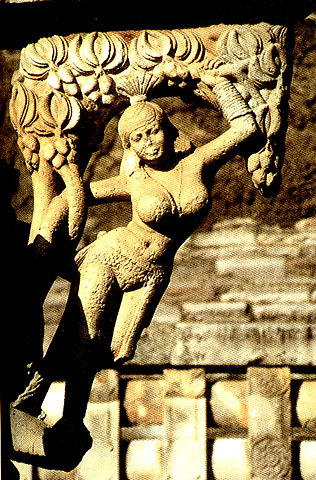
Kalidas's Meghdoot is a Yaksh's story. Yakshas and Yakshis are associated with nature and fertility. Often they are shown one with trees. The image is obtained from http://faculty.evansville.edu/rl29/art105/img/india_yakshi.jpg. More on Yakshas and Yakshis from Wikipedia.

Nagas - snakes - are associated with water. Hinduism has nagas in many form - Coiled around Shiva, The serpent on which Vishu is often shown in a reclining pose, and Shesh Nag, on whose head the world stands. Interestingly, why is Shesh Nag so called - the literal meaning of shesh is "remaining." More on Nagas from Wikipedia. Most of these images of Nagas are associated with water - Jain Tirthankar Parshvanath is shown on water; a Naga protects Buddha from rain; Shesh Nag was used for Sagar Manthan.

So, the origins of Hinduism are from a system of beliefs venerating - water, nature and fire.

Sunday, July 5, 2009

Aniconic and Iconic images in Indian Religion

In India, while there are millions of deities, with well-defined forms, there are also aniconic images that are worshiped regularly.

Examples of aniconic images include:
  1. Local devtas, typically called devis, bhairavs, peers etc. You see them by the side of the road, with a silver-colored foil and kumkum on them.
  2. Saligram (typically found on the bed of Gandaki river in Nepal) - represent Vishnu
  3. Stones from Vraj - represent Krishna
  4. Stones from Narmada - Bana Linga - representing Shiva
  5. Crafted shivlings
  6. Fire
(2, 3, and 4 above are considered to have divinity in them, and can be put in a temple, and their pooja started even without consecrating them.)

Monday, June 29, 2009

The Bamiyan Buddhas


Many of you may remember the uproar in 2001 when the Taliban in Afghanistan declared as unislamic, the two monumental statues of Buddha - 50 meters, and 36 meters tall. Unfortunately, the uproar had no effect, and the two Buddhas were destroyed.


See higher resolution version of the 1976 image.


Higher resolution version of the 2005 image.

Curious, that no one had any problem with these statues from the time Islam began - 8th century. It is only at the beginning of 21st century, that these statues were branded as unislamic. At around this time, thousands of pieces of Buddhist collection in museums in Afghanistan were also destroyed.

Fortuantely, many pieces were saved through courageous action by a few individuals, who risked their lives to save these pieces. The word is richer because of them.

By the way, this is not the first time these statues were attacked. In the 19th century, soldiers belonging to the occupying power - Britain - used these statues for target practice. Interesting.

Monday, June 22, 2009

Why is Buddhist art among the earliest art in India

Sometimes things fall into place, even without you knowing that there is a gap. We have all heard about Indus Valley Civilization, and the art-work from there. What Indian art is the next you hear about - Buddhist art. What happened to the intervening 1500 years?

Here is a plausible explanation:
  1. The civilization in India between 2nd millenium BCE and 5th century BCE focused on text rather than visual art. The following texts were written during that time (Vedas, Upnishads, Puranas, and the two great epics)

  2. It is possible that much of art of this period was made out of perishable material, e.g. wood.

  3. Some of the art that we consider to be post 3rd century BCE (e.g. Ashok's pillars) may have existed prior to Ashok; Ashok transformed them by inscribing on them, so now they are considered Ashok's pillars, and therefore Buddhist art.