Showing posts with label Naga. Show all posts

Wednesday, July 22, 2009

Naga of Ancient Indian Philosophy and Naga Babas


Is there a relation between Naga Babas - known mainly for initiating the Kumbh Mela every three years, and the ancient system of Indian belief that revered Nagas. (The above images are from: http://upload.wikimedia.org/wikipedia/commons/2/2f/Naga_baba.jpg and http://upload.wikimedia.org/wikipedia/en/1/19/Naga182.JPG)?

I would say yes, based only on one fact - Kumbh Mela is started by a march of the Naga Babas to the water. And, in traditional belief, Naga represented not just snakes, but also water. (More at http://isai-os.blogspot.com/2009/07/more-on-early-religion-of-india-nagas.html)

What I have not been able to figure out, is if this has anything to do with Nagaland, a state in India. Nagaland is now a mainly Christian state. However, there are references to the region being a traditional Naga culture, e.g. in Gita Mehta's book - River Sutra.

Tuesday, July 7, 2009

More on Early Religion of India - Nagas and Yakshs

Hinduism, Buddhism and Jainism borrowed extensively from the religion that existed in the land before them. There is evidence of this on all three kinds of temples.

It is believed that before 5th century BCE, the common element of worship was fire. In addition, there were other human type forms - Yakshas / Yakshis and Nagas.

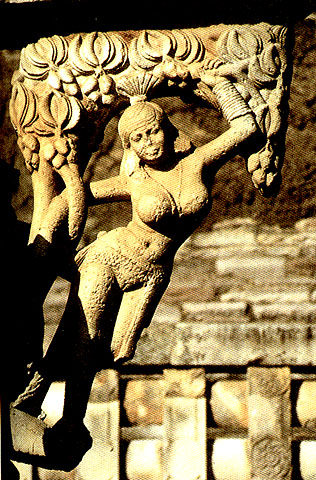
Kalidas's Meghdoot is a Yaksh's story. Yakshas and Yakshis are associated with nature and fertility. Often they are shown one with trees. The image is obtained from http://faculty.evansville.edu/rl29/art105/img/india_yakshi.jpg. More on Yakshas and Yakshis from Wikipedia.

Nagas - snakes - are associated with water. Hinduism has nagas in many form - Coiled around Shiva, The serpent on which Vishu is often shown in a reclining pose, and Shesh Nag, on whose head the world stands. Interestingly, why is Shesh Nag so called - the literal meaning of shesh is "remaining." More on Nagas from Wikipedia. Most of these images of Nagas are associated with water - Jain Tirthankar Parshvanath is shown on water; a Naga protects Buddha from rain; Shesh Nag was used for Sagar Manthan.

So, the origins of Hinduism are from a system of beliefs venerating - water, nature and fire.